Smart Glass Export Report 2025: Trends in Exports & Top Smart Glass Manufacturers & Suppliers
Discover the 2025 Smart Glass Export Report, covering global export trends, market growth, leading exporting countries, & top smart glass manufacturers & suppliers.


Introduction
Wearable smart glasses moved from niche consumer tech to a fast-growing global category in 2024. The rise of AI models that run efficiently on-device, lighter optical systems, better batteries, and improved microphones and cameras has turned smart glasses into a real alternative to smartphones for certain tasks. At the same time, enterprise adoption of AR optical systems continued to mature in manufacturing, warehousing, field service, and healthcare. All of this has pushed global shipments forward at a pace few consumer electronics categories match. According to the global trade data and smart glass export data, the total value of smart glass exports reached $4.40 billion in 2024, a 3% increase from the previous year.
Due to the high demand for Ray-Ban Meta smart glasses, global smart glass shipments increased 210% YoY in 2024 and 156% YoY in 2023. Exports of wearable smart glasses followed this surge. Companies in Asia, North America, and Europe fought for production capacity, supply chain stability, access to waveguide optics, and distribution into regions where consumer demand is rising. China, in particular, cemented itself as the dominant manufacturing hub for AI-powered camera glasses and mid-range AR glasses. Meanwhile, North American and European firms focused on premium consumer devices and high-spec enterprise AR solutions.
This report presents a detailed view of the smart glasses export landscape in 2024–25, covering technology trends, manufacturing clusters, supply chain shifts, export patterns, product categories, and competitive dynamics.
Smart Glass Market Growth and Acceleration in 2024–25
Global shipment growth
Smart glasses shipments grew at a remarkable rate in 2024. AI-powered camera glasses saw the strongest rise, driven by lower cost, light frames, and better quality microphones and cameras. Shipments were measured in the low millions in 2024, a sharp increase compared to previous years. The broader smart eyewear market, which includes AR optical systems, saw steady growth in both consumer and enterprise segments.
Three forces supported this global scale-up:
-
The explosion of interest in AI voice assistants that work hands-free.
-
Constant improvement in optical waveguides for AR systems opened new industrial use cases.
-
More fashion-forward hardware that made smart glasses feel like normal eyewear.
Based on 2024 growth, analysts projected a steep trajectory through 2025. Demand was strong across the United States, Europe, China, India, the Middle East, and several emerging markets, with growing interest in AI wearables.
-
The strong demand for Ray-Ban Meta Smart Glasses and the arrival of new companies like Xiaomi and TCL-RayNeo drove the global smart glasses market's 110% YoY growth in H1 2025.
-
Due to high demand and increased production capacity at Luxottica, its primary production partner, Meta's market share for smart glasses increased to 73% in the first half of 2025.
-
Key AI glasses OEMs that reached shipments in H1 2025, other than Meta, were Xiaomi, TCL-RayNeo, Kopin Solos, and Thunderobot. The industry's most anticipated event was the launch of Xiaomi's AI glasses.
-
In H2 2025, more AI glasses versions are anticipated to hit the market, including those from Meta, Alibaba, and a number of smaller companies.
-
Shipments of smart glasses exports increased 110% year over year in H1 2025. A significant demand for Ray-Ban Meta Smart Glasses and the arrival of new competitors like Xiaomi, TCL-RayNeo, and a number of smaller brands were the main causes of this increase.
-
Due in significant part to Ray-Ban Meta AI Glasses' supremacy, AI smart glasses made up 78% of all shipments in H1 2025, up from 46% in H1 2024 and 66% in H2 2024.
-
The AI glasses market rose by more than 250% year over year, much exceeding the market as a whole.
Revenue trajectory
Revenues grew rapidly, with consumer AI glasses contributing the largest share by volume while enterprise AR glasses delivered the highest margins. High-end AR systems sold at far higher prices than AI camera glasses, yet their unit growth was slower. Exporters benefited from both extremes. Low-cost producers in Asia moved high volumes. High-tech manufacturers in the United States, Israel, and parts of Europe captured large enterprise contracts and government orders.
Smart Glass Exports by Country: Which Countries Export the Most Wearable Smart Glasses?
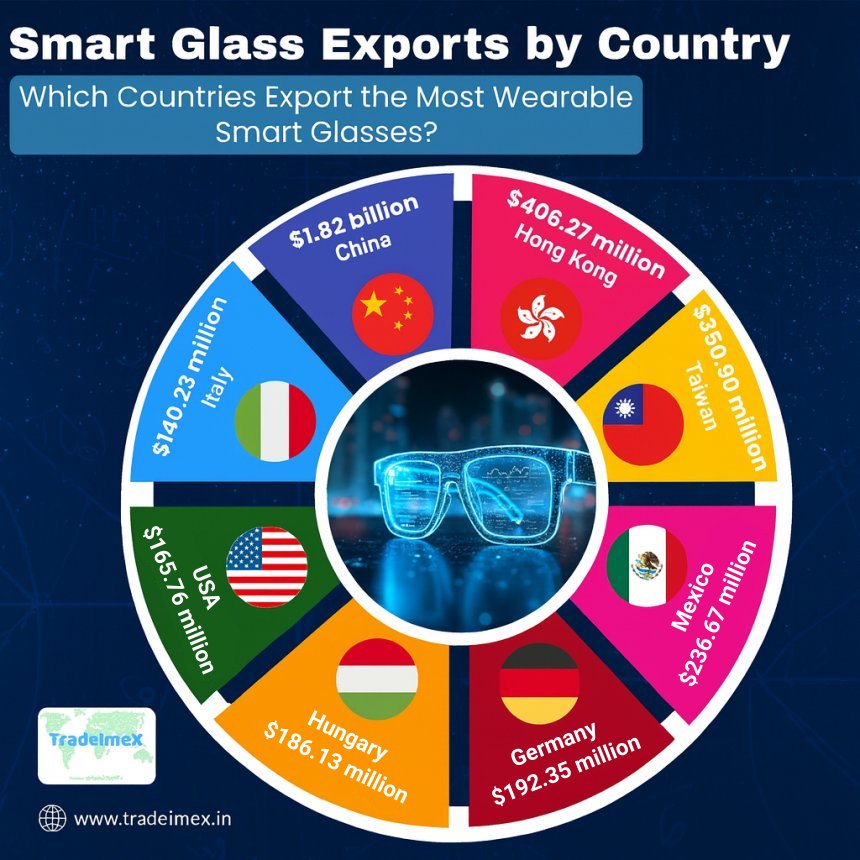
The global market for wearable smart glasses is experiencing steady growth, with several countries establishing themselves as key players in smart glass exports. In today's fast-paced technological world, wearable smart glasses have become increasingly popular for their convenience and functionality. As the demand for these innovative devices continues to rise, it's interesting to explore which countries are leading the way in exporting wearable smart glasses.
According to data on Smart Glass Exports by Country, countries such as China, Hong Kong, and Mexico top the list as the leading exporters of wearable smart glasses. These nations have demonstrated a strong commitment to innovation and technological advancement, which has contributed significantly to their success in the smart glass market. The top 10 smart glass exporting countries, as per the smart glass shipment data for 2024-25, include:
1. China: $1.82 billion (41.4%)
China is at the forefront of smart glass exports, accounting for a significant 41.4% of the total global market share. With a booming technology industry and a focus on innovation, Chinese manufacturers have been able to produce high-quality wearable smart glasses that are in high demand worldwide.
2. Hong Kong: $406.27 million (9.2%)
Hong Kong is another key player in the smart glass export market, capturing 9.2% of the total market share. Known for its advanced manufacturing capabilities and strategic location for international trade, Hong Kong has established itself as a major exporter of wearable smart glasses.
3. Taiwan: $350.90 million (8%)
Taiwan has emerged as a significant player in the wearable smart glass export industry, accounting for 8% of the global market share. With a strong focus on research and development, Taiwanese companies have been able to produce cutting-edge smart glasses that are in high demand among consumers.
4. Mexico: $236.67 million (5.4%)
Mexico has also made its mark in the wearable smart glass export market, capturing 5.4% of the total market share. With a growing technology sector and a skilled workforce, Mexican manufacturers have been able to produce competitive smart glasses that cater to a global audience.
5. Germany: $192.35 million (4.4%)
Germany, known for its precision engineering and technological expertise, holds a significant share of the smart glass export market at 4.4%, as per the Germany smart glass export data by HS code. German manufacturers have been able to leverage their innovation and quality standards to produce wearable smart glasses that are highly sought after in the international market.
6. Hungary: $186.13 million (4.2%)
Hungary has also established itself as a key player in the smart glass export industry, capturing 4.2% of the global market share. With a focus on advanced technology and a skilled workforce, Hungarian manufacturers have been able to produce smart glasses that meet the needs of tech-savvy consumers.
7. USA: $165.76 million (3.8%)
The United States, a technology powerhouse, holds a 3.8% share of the wearable smart glass export market. With a focus on innovation and cutting-edge research, US companies have been able to produce smart glasses that cater to a wide range of consumers around the world.
8. Italy: $140.23 million (3.2%)
Italy, known for its design and craftsmanship, has carved out a niche in the smart glass export market, capturing 3.2% of the total market share, as per the Italy smart glass export data by HS code. Italian manufacturers have been able to combine style and functionality to produce wearable smart glasses that appeal to fashion-conscious consumers.
9. France: $139.49 million (3.2%)
France, a hub for technology and innovation, holds a 3.2% share of the global smart glass export market. With a focus on research and development, French companies have been able to produce smart glasses that offer cutting-edge features and design.
10. Thailand: $109.28 million (2.5%)
Thailand has also made its mark in the wearable smart glass export market, capturing 2.5% of the total market share. With a growing technology sector and a focus on quality manufacturing, Thai companies have been able to produce smart glasses that are competitive in the global market.
List of Top Smart Glass Manufacturers & Suppliers: Smart Glasses Exporters Database
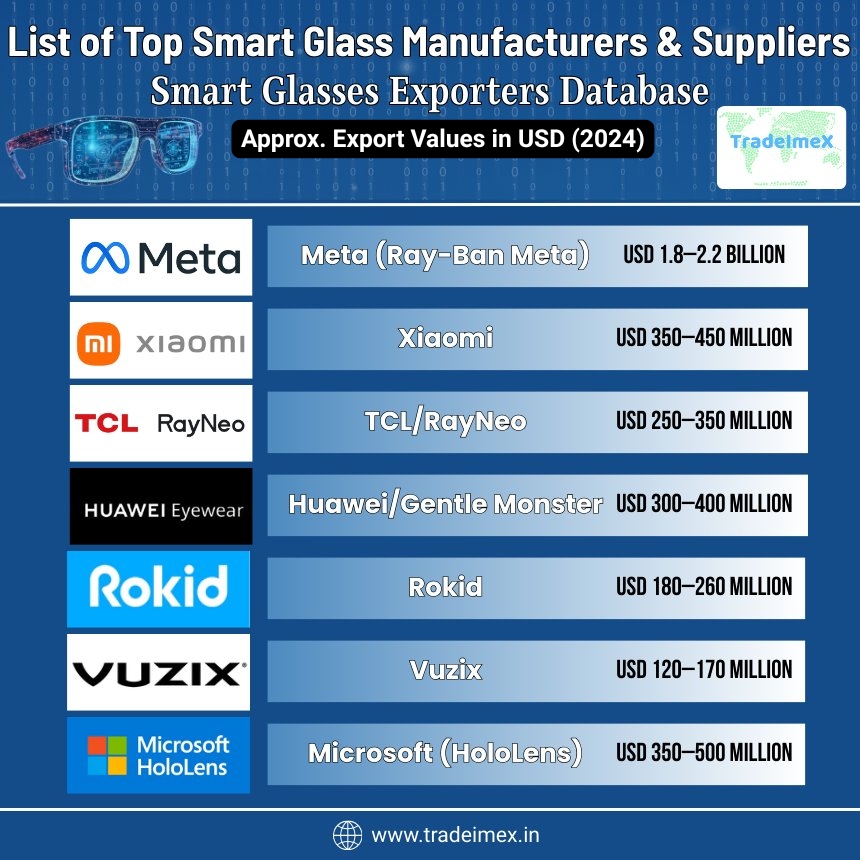
Global Smart Glasses Exporters Database provides a comprehensive resource for individuals and companies looking to navigate the world of smart glasses. This database showcases the top manufacturers and suppliers in the industry, offering valuable insight into the global market. Whether you are a tech enthusiast, a business owner, or a researcher, this database serves as a go-to platform for accessing valuable information and connecting with key players in the smart glasses sector. The leading smart glass manufacturers & exporters in the world, as per the smart glass manufacturers list & smart glass suppliers data for 2024-25, include:
|
Company |
Approx. Export Value (2024) |
Top Exported Smart Glasses |
Main Export Markets |
|
USD 1.8–2.2 billion |
Ray-Ban Meta Smart Glasses |
US, Europe, the Middle East, & Australia |
|
|
Xiaomi |
USD 350–450 million |
Xiaomi AI Smart Glasses |
China, India, Southeast Asia, & Europe |
|
TCL/RayNeo |
USD 250–350 million |
RayNeo V3, RayNeo XR models |
China, Europe, Latin America |
|
Huawei/Gentle Monster |
USD 300–400 million |
Huawei × Gentle Monster Smart Glasses |
China, Europe, the Middle East |
|
Rokid |
USD 180–260 million |
Rokid Max, Rokid AR, and AI glasses |
China, the United States, & Europe |
|
Vuzix |
USD 120–170 million |
Vuzix M400, Vuzix Blade 2, Vuzix Shield |
United States, Europe, Japan |
|
Microsoft (HoloLens) |
USD 350–500 million |
HoloLens 2 (enterprise MR) |
United States, Europe, South Korea, Japan |
|
Lenovo |
USD 90–130 million |
Lenovo ThinkReality AR Glasses |
China, United States, Germany, Singapore |
|
Magic Leap |
USD 150–220 million |
Magic Leap 2 |
United States, Europe, Middle East |
|
Nreal / XREAL |
USD 200–300 million |
XREAL Air, XREAL Light |
United States, Europe, South Korea |
Short Summary
-
Meta holds the strongest global export position, driven by mass-market adoption and fashion integration.
-
China-based manufacturers (Xiaomi, TCL/RayNeo, Huawei, Rokid, XREAL) dominate mid-range AI and AR glasses exports.
-
Enterprise AR exports come mainly from Microsoft, Vuzix, and Magic Leap, with high per-unit value.
-
Export demand in 2024–25 is strongest in North America, Europe, China, India, and the Middle East.
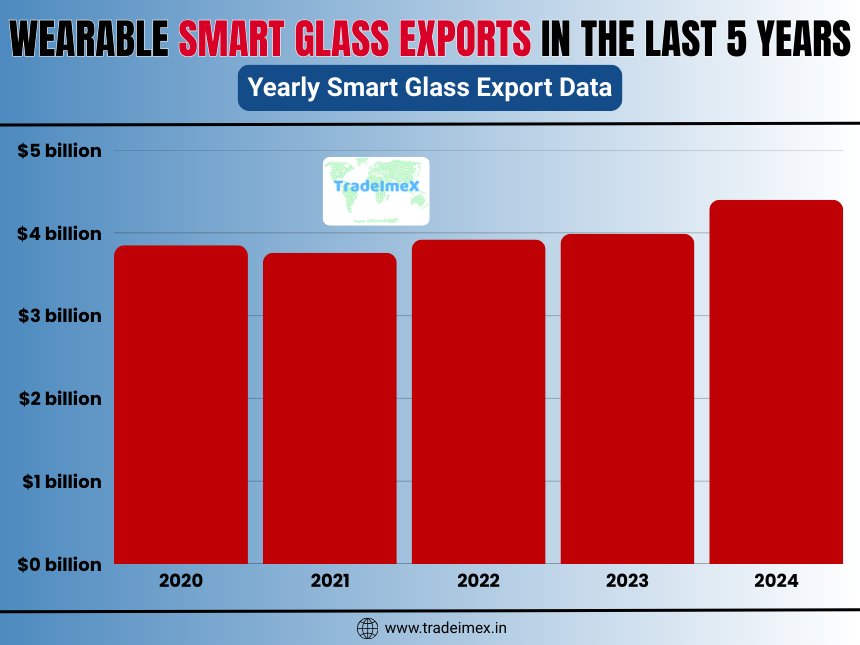
Wearable Smart Glass Exports in the Last 5 Years: Yearly Smart Glass Export Data
|
Year of Exports |
Global Smart Glasses Export Value ($) |
|
2020 |
$3.85 billion |
|
2021 |
$3.76 billion |
|
2022 |
$3.92 billion |
|
2023 |
$3.99 billion |
|
2024 |
$4.40 billion |
Product Categories Driving Export Demand
Smart glasses are not a single technology. Export patterns differ because each category serves different customers, price points, and use cases. In 2024–25, the market was defined by three major categories.
1. AI camera glasses
These are lightweight, fashionable, and aimed at everyday consumers. They usually offer:
-
A front camera
-
Beamforming microphones
-
Voice assistant integration
-
Instant image and video capture
-
Hands-free communication
-
AI summarization and real-time translation in some models
AI glasses led global shipments in 2024. They dominate export flows because they are easier to manufacture, use mass-market components, and fit into traditional eyewear distribution channels. China is the core exporter of this category, followed by a smaller number of manufacturers in the United States and South Korea.
2. Consumer AR glasses
Consumer AR glasses use waveguides or micro projectors to display floating images or heads-up information. These displays support:
-
Navigation
-
Fitness information
-
Real-time captions
-
Notifications
-
Lightweight entertainment
Exports of consumer AR glasses grew as waveguide supply increased and prices slowly declined. These glasses are more complex than AI camera glasses due to the optics, so they tend to come from more specialized manufacturers. China and Israel supply most of the waveguide components, while final assembly varies by brand.
3. Enterprise AR glasses
Enterprise AR glasses serve industries that rely on remote expert guidance, workflow automation, digital twins, and field operations. These glasses are rugged, powerful, and built for extended daily use. Features include:
-
High brightness waveguide or microdisplay
-
Rugged build
-
Hot-swappable batteries
-
Voice control
-
Environmental sensors
-
Industrial certifications
Enterprise AR glasses have the highest export margins, with manufacturers in the United States, Europe, and China competing for large enterprise and government contracts. Exports in this segment increased due to strong adoption in manufacturing, aerospace, exports, and maintenance.
Export Patterns and Manufacturing Hubs
1. China as the dominant exporter
China continued to lead global exports of smart glasses in 2024–25. Several factors supported this dominance:
-
Extensive consumer electronics manufacturing infrastructure
-
Access to low-cost optical components
-
Massive capacity for injection molding, circuit assembly, and battery production
-
Aggressive domestic competition that accelerates innovation
-
Large AI-wearable companies targeting the global market
Cities with strong smart glasses production include Shenzhen, Guangzhou, Dongguan, and Chengdu. These hubs handle everything from optical modules to final assembly.
2. North America as a premium exporter
Manufacturers in the United States exported both premium consumer AI glasses and enterprise AR glasses. The domestic market remained strong, but exports also rose in Europe, the Middle East, and Asia. North American firms excel at:
-
High-end optics
-
Voice recognition and AI processing
-
Wearable comfort and industrial design
-
Rugged enterprise hardware
Production is often split between the United States for core technology and Asian partners for assembly, but finished devices are exported under U.S. branding.
3. Europe’s steady presence
Europe retained a strong position in optical technology, industrial AR systems, and premium consumer eyewear, as per the Europe trade data. European exports are smaller in volume compared to China, but often higher in value. Key strengths include:
-
Optical waveguide engineering
-
Luxury eyewear design
-
Highly regulated enterprise solutions for medical and industrial use
Countries like Germany, France, Italy, and the Netherlands chipped in with specialized components and finished systems.
4. Israel as a critical optics supplier
Israel’s role in the smart glasses export ecosystem grew in 2024–25 due to its waveguide and optical display companies. These suppliers shipped components to AR manufacturers in China, the United States, and Europe. Without these waveguides, many high-end AR glasses would not exist.
Supply Chain and Component Exports
The supply chain for smart glasses is complex and dependent on several high-tech components. These components are exported separately and assembled in final manufacturing hubs.
1. Optical waveguides
Waveguides are the heart of consumer and enterprise AR glasses. They are thin, transparent pieces of glass or plastic that guide light from a projector into the user’s eyes.
Exporters include:
-
Israeli waveguide makers
-
Chinese optical module companies
-
North American AR component developers
Waveguides have tight tolerances and high margins, which creates opportunities for high-value exports.
2. Microdisplays
Microdisplays for AR glasses include:
-
Micro OLED
-
Micro LED
-
LCOS
Japan, South Korea, China, and the United States play central roles in supplying these. Micro OLED exports increased sharply as more consumer AR glasses adopted the technology.
3. Cameras and sensors
Cameras for AI glasses are small, high-quality, and optimized for hands-free operation. Sensors include:
-
IMU
-
GPS
-
Depth sensors for certain enterprise systems
-
Environmental sensors for industrial AR
Most of these components come from China, South Korea, and Japan.
4. Batteries and power management
Battery exports grew alongside glasses shipments. Low-power silicon and improved thermal management also became key export categories.
Leading Global Smart Glass Manufacturers & Exporters
Below is a list of major smart glasses manufacturers with strong export operations. Detailed company descriptions highlight export positioning without mentioning any links.
1. Meta
Meta’s smart glasses, produced in partnership with a global eyewear manufacturer, drove the bulk of consumer AI glasses exports. The frames look like ordinary sunglasses, and that comfort helped them succeed internationally. Meta established strong export channels into North America, Europe, the Middle East, and parts of Asia.
2. Xiaomi
Xiaomi entered the AI glasses category with aggressive pricing and rapid release cycles. Early batches sold in large numbers, and Xiaomi became one of the fastest-growing exporters of consumer AI glasses. Much of the production remained in China with direct export to overseas retail and online markets.
3. Huawei and Gentle Monster
This collaboration blended fashion with tech. Huawei handled the electronics while Gentle Monster contributed eyewear design. Exports of these glasses were strongest in Asia and Europe.
4. RayNeo and other Chinese OEMs
A wave of Chinese manufacturers released AI smart glasses in 2024–25. These companies targeted the global market with lightweight frames, competitive pricing, and fast turnaround times. Their export destinations included the United States, Europe, the Middle East, and India.
5. Rokid
Rokid strengthened its position in AR glasses, exporting consumer and enterprise models. Its AR systems gained traction in industrial training, remote support, and entertainment.
6. Vuzix
Vuzix remained an important exporter of enterprise AR glasses from the United States. Its rugged glasses are shipped to manufacturing and healthcare customers around the world.
7. European optical and AR specialists
Companies in Germany, France, and the Netherlands exported enterprise AR glasses and optical systems, often at the high end of the market. These exports focused on the medical, aerospace, and industrial sectors.
8. Israeli optical innovators
Israel exported critical waveguide modules used in many AR products. These exports supported both consumer and enterprise AR companies around the world.
Smart Glasses Export Trends for 2024–25
Growth in consumer AI glasses exports
Consumer AI glasses accounted for the majority of shipment volume, as per the AI glass export data. The shape of demand favored:
-
Lightweight frames
-
High-quality microphones
-
Good cameras
-
Solid AI assistant performance
Exports to the United States and Europe rose fastest due to high consumer interest.
Rapid expansion of mid-range AR glasses
Affordable AR glasses with waveguide displays became more available in 2024. This created new mid-tier export opportunities, especially for Chinese manufacturers that could produce waveguides on a large scale.
Enterprise AR is becoming a global export staple
Enterprise AR glasses saw steady export growth. Manufacturers shipped to factories, hospitals, export companies, and field service teams across major economies. Exports were tied to large contracts rather than consumer retail.
Increase in regionalized assembly
To reduce duties and shipping costs, several brands established regional assembly points. This trend is expected to grow through 2025.
Challenges for Exporters
-
Privacy concerns around AI camera glasses can slow regulatory approvals.
-
AR manufacturing remains expensive.
-
Waveguide supply is limited, which puts pressure on lead times.
-
Shipping fragile optics requires specialized packaging.
-
Enterprise buyers demand long-term support, not just devices.
-
Currency fluctuations affect export margins.
Wearable Smart Glasses 2025 Outlook
Exports of smart glasses will continue rising due to:
-
Broader adoption of AI wearables
-
New AR optical breakthroughs
-
Expansion of manufacturing in China, Israel, the United States, and Europe
-
More regional variants tuned for language and local AI systems
-
Growth in enterprise remote assistance and automation
By the end of 2025, AI glasses could reach a level of global penetration similar to early smartwatches. AR glasses, both consumer and enterprise, will continue their steady climb as waveguides improve and prices fall.
Conclusion and Final Thoughts
In conclusion, wearable smart glasses shifted from experimental gadgets to a fast-advancing global product category in 2024. AI camera glasses took the lead in volume, consumer AR glasses strengthened their foothold, and enterprise AR systems continued to secure long-term industrial contracts. Exports followed this momentum. China dominated volume production, the United States and Europe held their ground in premium and enterprise segments, and Israel supplied much of the waveguide technology that makes modern AR systems possible.
The export landscape for 2025 will be shaped by the same forces that drove the 2024 surge: better on-device AI, lighter frames, stronger optical systems, and higher demand for hands-free technology in both everyday life & heavy industry. Supply chain maturity, diversified assembly hubs, and improved optical yields will allow exporters to scale further.
For more information on the wearable smart glasses import-export data, or to search live data on smart glass exports by country, visit TradeImeX. Contact us at info@tradeimex.in for customized trade reports and a verified database of the top wearable smart glasses exporters & suppliers, as per your needs.
Share
What's Your Reaction?
 Like
0
Like
0
 Dislike
0
Dislike
0
 Love
0
Love
0
 Funny
0
Funny
0
 Angry
0
Angry
0
 Sad
0
Sad
0
 Wow
0
Wow
0