
Canada–Mexico Trade Analysis 2025: NAFTA to USMCA—Bilateral Trade Data Tells the Story
Explore Canada–Mexico trade in 2025 with an in-depth analysis of post-NAFTA changes under USMCA. Discover trade data & impacts driving bilateral trade.


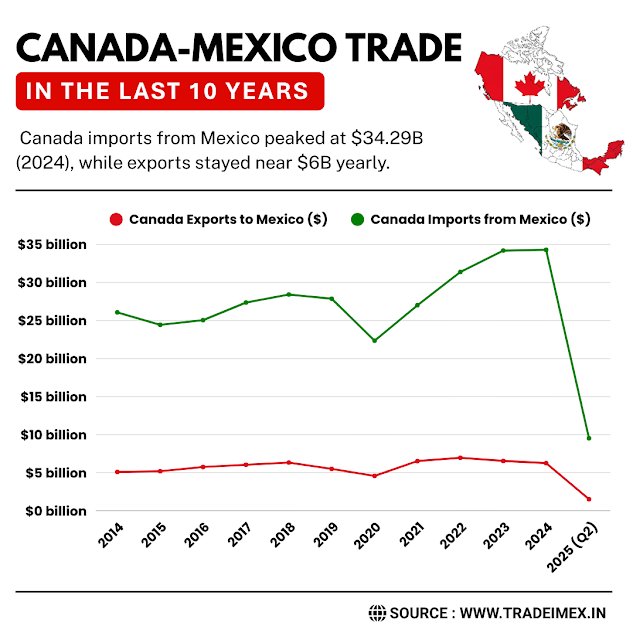
Since NAFTA’s inception in 1994 and its modernization through the United States-Mexico-Canada Agreement (USMCA), effective July 1, 2020, Canada–Mexico trade has been a quiet powerhouse, integral to North America's supply chains, yet often overshadowed by US–Canada or US–Mexico headlines. Let’s unpack the latest 2024 data through 2025 to see how this bilateral relationship has evolved, and why it matters more than ever. According to the latest Mexico export data and Canada import data, the total value of Canada imports from Mexico reached $34.29 billion in 2024, while Canada exports to Mexico accounted for a total value of $6.27 billion, as per the Canada export data and Mexico import data.
As per the Canada-Mexico trade data and global trade data, the total bilateral trade between Canada & Mexico reached over $56 billion in 2024-25. In the ever-evolving landscape of international trade, the relationship between Canada and Mexico has been a significant one. With the recent transition from NAFTA to USMCA, the dynamics of bilateral trade between these two North American countries have transformed. In this article, we will analyze the trade data from 2025 to understand how the shift from NAFTA to USMCA has impacted the Canada–Mexico trade relationship.
The Transition from NAFTA to USMCA
The North American Free Trade Agreement (NAFTA) was a trilateral trade agreement between Canada, Mexico, and the United States that came into effect in 1994. Over the years, NAFTA facilitated significant trade between Canada and Mexico, leading to the growth of various industries in both countries.
However, with the changing global economic landscape, the three countries agreed to modernize the agreement, leading to the creation of the United States-Mexico-Canada Agreement (USMCA) in 2020.
Impact on Bilateral Trade
The transition from NAFTA to USMCA brought about several changes that have influenced the bilateral trade between Canada and Mexico. One of the key aspects of the USMCA is the inclusion of updated provisions related to digital trade, intellectual property rights, and labor rights. These provisions have helped create a more balanced and fair-trading environment between the two countries. With $46.4 billion in direct investment, Canadian businesses made Mexico their ninth-largest target for direct investment, as per the North America Trade Data.
In 2025, the trade data between Canada and Mexico shows a steady increase in the volume of trade in various sectors. The automotive industry, in particular, has seen significant growth, with both countries benefiting from the updated rules of origin under the USMCA. This has led to increased investment in the automotive sector, creating jobs and driving economic growth in both Canada and Mexico.
Two-Way Canada-Mexico Trade: How Big Is It?
Merchandise Trade Value (2024)
According to Global Affairs Canada, Canada–Mexico two-way merchandise trade reached nearly USD 56 billion in 2024, making Mexico Canada's third-largest single-country trading partner after the U.S. and China, while Canada ranked as Mexico’s fifth-largest partner. In the first 2 quarters of 2025, the total value of Canada imports from Mexico reached $9.54 billion, while Canada exports to Mexico totaled $1.53 billion, as per the Canada trade data and Mexico customs data.
Historical Perspective
For context, in 2023, the Canada-Mexico bilateral trade stood at approximately USD 28.7 billion, so 2024's figure nearly doubles that amount, suggesting a major trade surge. This growth underscores deepening ties not just in traditional sectors but across emerging domains like technology and renewable energy components.
Canada-Mexico Trade in the Last 10 Years: Historical Bilateral Trade Data
|
Year of Trade |
Canada Imports from Mexico ($) |
Canada Exports to Mexico ($) |
|
2014 |
$26.07 billion |
$5.11 billion |
|
2015 |
$24.44 billion |
$5.20 billion |
|
2016 |
$25.05 billion |
$5.76 billion |
|
2017 |
$27.36 billion |
$6.05 billion |
|
2018 |
$28.42 billion |
$6.34 billion |
|
2019 |
$27.87 billion |
$5.51 billion |
|
2020 |
$22.35 billion |
$4.59 billion |
|
2021 |
$27.01 billion |
$6.54 billion |
|
2022 |
$31.38 billion |
$6.98 billion |
|
2023 |
$34.19 billion |
$6.56 billion |
|
2024 |
$34.29 billion |
$6.27 billion |
|
2025 (till Q2) |
$9.54 billion |
$1.53 billion |
Trade Composition & Key Sectors: Top Traded Goods Between Canada & Mexico

Key Exports From Canada to Mexico: Canada’s exports span a diversified set of categories:
-
Vehicles (HS code 87): $1.28 billion
-
Nuclear Reactors & Machinery (HS code 84): $718.37 million
-
Meat & Edible Meat Offal (HS code 02): $538.75 million
-
Electrical Machinery & Equipment (HS code 85): $459.90 million
-
Iron & Steel (HS code 72): $344.60 million
Key Exports From Mexico to Canada: Mexico’s exports to Canada include:
-
Vehicles (passenger and transport) (HS code 87): $9.59 billion
-
Nuclear Reactors & Machinery (HS code 84): $2.71 billion
-
Electrical Machinery & Equipment (HS code 85): $1.80 billion
-
Furniture, bedding, and mattresses (HS code 94): $574.73 million
-
Articles of iron or steel (HS code 73): $571.77 million
This data reflects a complex value chain, agricultural inputs, energy and minerals, and integrated manufacturing components, all essential to both economies.
Complementarity & Investment
Cross-border investment also deepens integration. In 2024, Canadian Direct Investment in Mexico totaled USD 46.4 billion, placing Mexico as the ninth-largest destination for Canadian FDI. Meanwhile, in 2022, Canadian companies had invested around USD 33 billion in Mexico. These figures highlight reciprocal business engagement.
NAFTA vs USMCA: Structural Shifts & Trade Stability
USMCA Upgrades over NAFTA
NAFTA’s long-standing rules were modernized under USMCA starting July 1, 2020. The new agreement was introduced:
-
Stronger labor and environmental protections
-
Upgraded rules of origin, especially in autos and auto parts
-
Digital trade frameworks and investment provisions
Trade Stability Amid Turbulence
The arrival of USMCA provided legal clarity for sourcing inputs and moving goods cross-border. As a result, North American supply chains, including those involving Canada and Mexico, became more predictable and resilient.
Enter the Tariff Storm: 2025 US Actions & USMCA Exemptions
American Tariff Escalation
In early 2025, the U.S. under President Trump's administration reintroduced sweeping tariffs:
-
25% tariffs on most Mexican goods
-
35% on most Canadian goods, with 10% for energy and potash
-
Exemptions remain for USMCA-compliant goods, albeit only 38% (Canada) and 50% (Mexico) of goods fell under formal certification in 2024.
-
Despite these steep tariffs, over 85% of Canada–U.S. trade and 84% of Mexico–U.S. trade remains tariff-free, thanks to USMCA exemptions.
Reported Impact Estimates
Analysts from Trade Partnership Worldwide estimate 2024 US imports duty-free under USMCA at 50% for Mexico and 38% for Canada; only 10% of total Mexican exports and 22% of Canadian exports faced any tariffs.
Sector-Specific Effects
Tariffs still bite in key areas:
-
Steel, aluminum: 50%
-
Autos not meeting USMCA rules: 25%
These disrupt long-standing industrial ties, especially where automotive or energy integration is deep.
How Canada–Mexico Trade Fits into the USMCA Triangle
Regional Trade in Perspective
In 2024, U.S.–Canada goods trade totaled approximately USD 761.8 billion; exports were USD 349.9 billion, imports USD 411.9 billion, yielding a goods trade deficit of USD 62.0 billion for the US. USMCA, overall, covered USD 1.8 trillion in U.S. goods and services trade in 2022, highlighting how significant Canada and Mexico are collectively.
In North America, Mexico led two-way commerce in 2024 with the U.S. (USD 848 billion), followed by Canada (USD 764 billion) and then China, significantly trailing at USD 578 billion.
Broader Economic Impacts & Strategic Significance
For Canada
-
Total merchandise trade (US+Mexico) accounted for two-thirds of GDP in 2024. The U.S. accounted for most of that, but Mexico’s share is not negligible.
-
The trade surplus with the U.S. (C$170 billion) is energy-driven; excluding energy, the U.S. runs a surplus.
For Mexico
-
The U.S. accounts for 80% of Mexico’s foreign trade, while Canada represents less than 3%, meaning Mexico is highly reliant on the U.S., with Canada as a growing but still smaller partner.
Co-Dependence and Supply Chains
-
Cross-border supply chains are extensively integrated, especially in autos: goods can cross multiple borders before final assembly. 17% of Canadian merchandise exports to the U.S. were U.S.-origin, processed in Canada, then re-exported.
Strategic Resilience
Mexico-Canada trade is both a buffer and a bellwether, smaller in absolute volume than U.S. corridors but essential for diversified North American supply networks.
2025–26 Outlook: Review & Rebalance
-
USMCA’s Joint Review Ahead
A scheduled trilateral review of USMCA is due in 2026, making 2025 pivotal for policy recalibration.
-
Diplomatic Pivoting
Canada’s Prime Minister (Mark Carney) is set to visit Mexico in Sept 2025. Discussions will focus on trade diversification amid ongoing U.S. tariffs and the upcoming USMCA review.
-
Economic Tensions & Retaliation Risks
The USMCA’s tariff exemptions have softened the immediate impact, but rising uncertainty, plus protectionist U.S. tariffs, could push Canada and Mexico toward seeking alternative markets or further deepening bilateral ties.
Trade in Agricultural Products
Agricultural trade between Canada and Mexico has also seen a positive impact from the transition to USMCA. The agreement includes provisions that address issues such as biotechnology, sanitary and phytosanitary measures, and geographic indications, which have helped facilitate trade in agricultural products between the two countries. In 2025, the trade data shows an increase in the export of Canadian agricultural products to Mexico, with a particular focus on commodities such as wheat, barley, and canola.
Challenges and Opportunities
While the transition from NAFTA to USMCA has brought about several benefits for the Canada–Mexico trade relationship, there are also challenges that both countries need to address. One of the significant challenges is the ongoing trade disputes between the two countries, particularly in sectors such as steel and aluminum. Resolving these disputes and ensuring fair trade practices will be crucial for fostering a strong and sustainable trade relationship between Canada and Mexico.
Despite the challenges, there are also significant opportunities for growth and cooperation between Canada and Mexico. The USMCA provides a framework for deeper integration and collaboration in various sectors, including energy, technology, and services. By leveraging these opportunities, both countries can strengthen their trade ties and build a more resilient economic partnership.
Conclusion and Final Verdict
The transition from NAFTA to USMCA has ushered in a new era of trade relations between Canada and Mexico. The trade data from 2025 highlights the positive impact of the agreement on various sectors, including automotive and agriculture. While challenges remain, the opportunities for growth and cooperation between the two countries are promising. From modest beginnings under NAFTA to a more modernized framework under USMCA, Canada–Mexico trade has grown significantly, both in volume and strategic value.
In 2024 alone, two-way merchandise trade was nearly USD 56 billion, with diverse sectors, from energy and agriculture to autos and aerospace, interwoven across borders. Yet, despite geopolitical and protectionist shifts in 2025, USMCA’s tariff exemptions shielded the bulk of trade, keeping 84–85% of trade flows tariff-free. Tariffs continue to strain sensitive sectors, but predictability and legal mechanisms under USMCA remain essential.
Looking ahead, as North America confronts rising protectionism and trade tensions, Canada–Mexico trade is poised to strengthen its role as a stabilizing force, one that could help both countries navigate global economic turbulence, reduce reliance on U.S. dynamics, and pave the way for more resilient, diversified, and mutual growth.
We hope that you liked our data-driven and interactive blog report on Canada-Mexico trade analysis 2025. For more such global trade trends or to search live import-export data of 100+ countries, visit TradeImeX. Contact us at info@tradeimex.in for customized trade data reports, market insights, and the latest importer-exporter database.
Share
What's Your Reaction?
 Like
0
Like
0
 Dislike
0
Dislike
0
 Love
0
Love
0
 Funny
0
Funny
0
 Angry
0
Angry
0
 Sad
0
Sad
0
 Wow
0
Wow
0